The material culture of women is never far beneath the surface of Joana Vasconcelos’s maximalist sculptures. The Portuguese artist came to international acclaim with a chandelier-shaped sculpture, A Novia (The Bride; 2001–5), first exhibited at the 2005 Venice Biennial. Made of approximately 14,000 tampons, the twenty-foot-high work constructed drama from an object associated with fertility and silence. Fast-forward two decades and Andrea Sheehan’s portrait of the late Ruth Bader Ginsburg assembled from hand-painted tampons now graces the lobby of Hotel Zena in Washington, D.C., while a taboo-breaking tampon-sex scene appears in Miranda July’s popular perimenopause novel All Fours (2024). Vasconcelos’s prescient choice of material offered a vision of beauty shaped by objects that continue, for some, to be associated with shame.
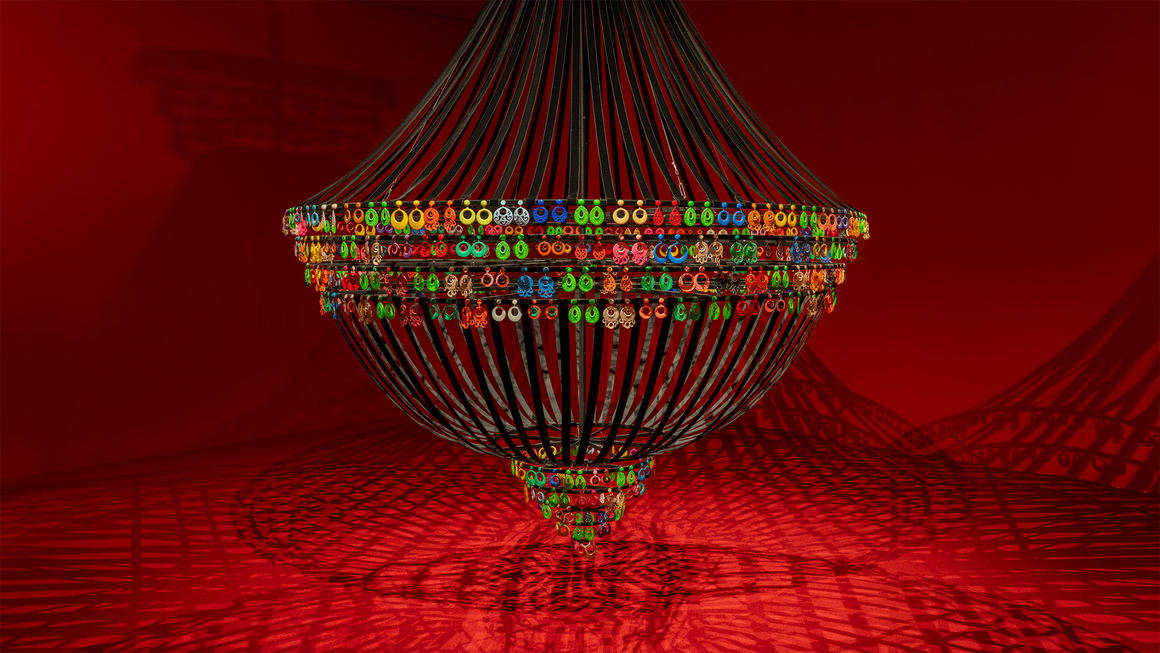
At a visit to the Museo Picasso Malága, I saw her solo exhibition Transfiguration, which features a chandelier of a different type. Made of velvet ribbon and ringed with colorful plastic earrings that cast intricate shadows, Carmen (2001) hangs in a gallery where the music of Georges Bizet’s 1875 comic opera—also set in Andalusia—plays. The cheap earrings (with a little time travel) belong as much to Carmen’s story as the black velvet ribbon of mourning. Vasconcelos has made such mixing of references to high and low culture into a thriving career.
Portuguese craft is a further touchstone for the artist. In Coração Independente Preto (Black Independent Heart; 2006), plastic cutlery morphs into an oversized necklace pendant of overlapping hearts. Part of a trio that includes red and yellow versions, each sculpture takes the shape of the Heart of Viana symbol, traditionally made of gold or silver filigree. Amália Rodrigues singing fado, a melancholic music genre, plays in the background. Vasconcelos explains that her choice of plastic cutlery exposes “the artificiality of the boundaries separating luxury and banality.” Stripped of preciousness, heritage is instead activated through material exuberance.
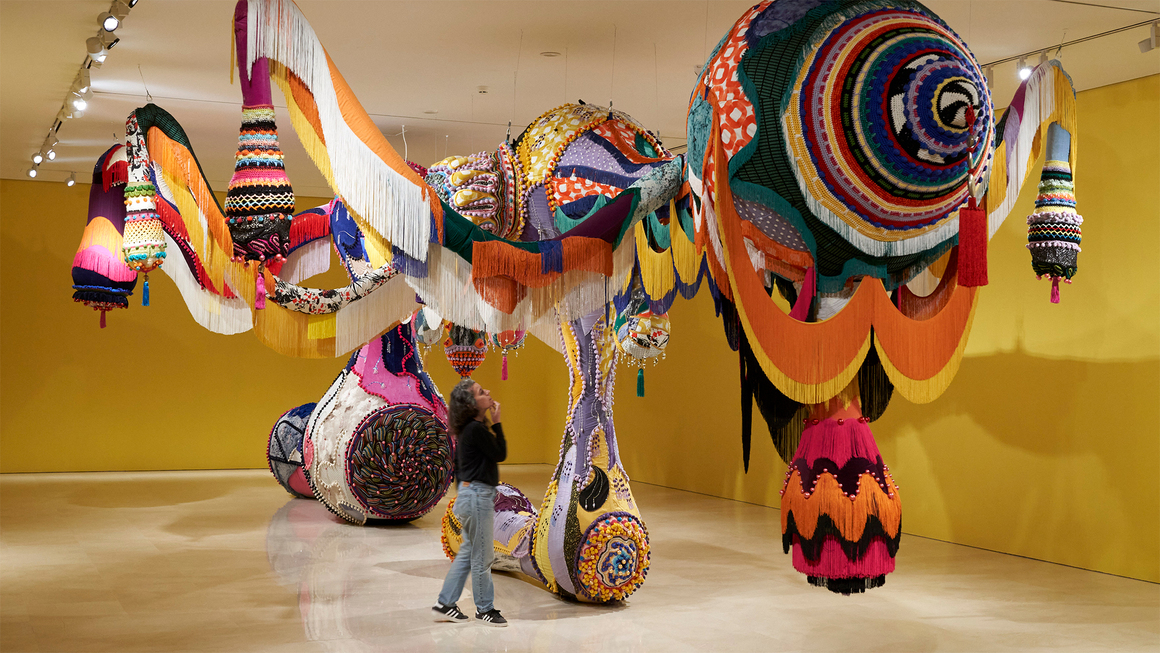
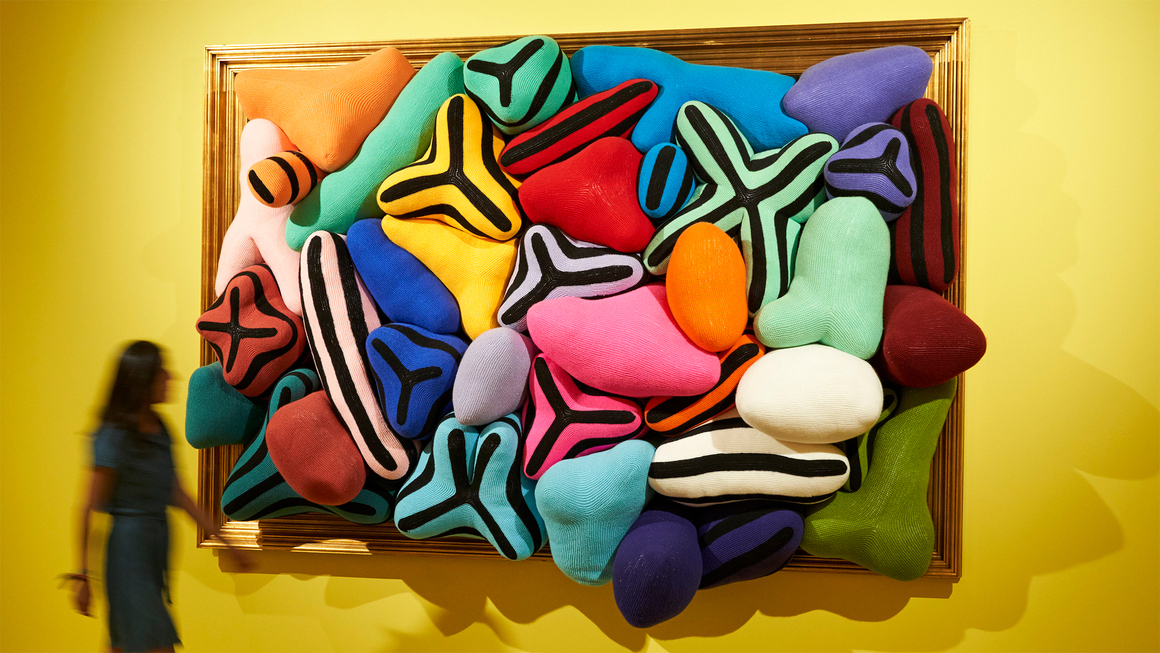
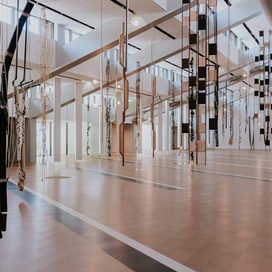
My eye was also drawn to the use of crochet and embroidery throughout the exhibition. The sculpture Valkyrie Marina Rinaldi (2014) refers to the female figures of Norse mythology who guide the souls of slain warriors to Valhalla. This sculpture, part of Vasconcelos’s ongoing Valkyrie series, takes its title from the plus-size fashion brand that commissioned it. Another Portuguese artist tells me the sculpture’s hovering quality is achieved through inflated forms that support the visible textile skin. Neither droopy or overtly suspended, each form somehow feels full. More textiles appear in Loft (2010–17), in which the artist treats the home as a place of not only refuge but also secrets, a site of intimacy and estrangement now turned public. Adorned with tassels and beads, plump textiles snake through twelve freestanding walls that suggest various domestic interiors.
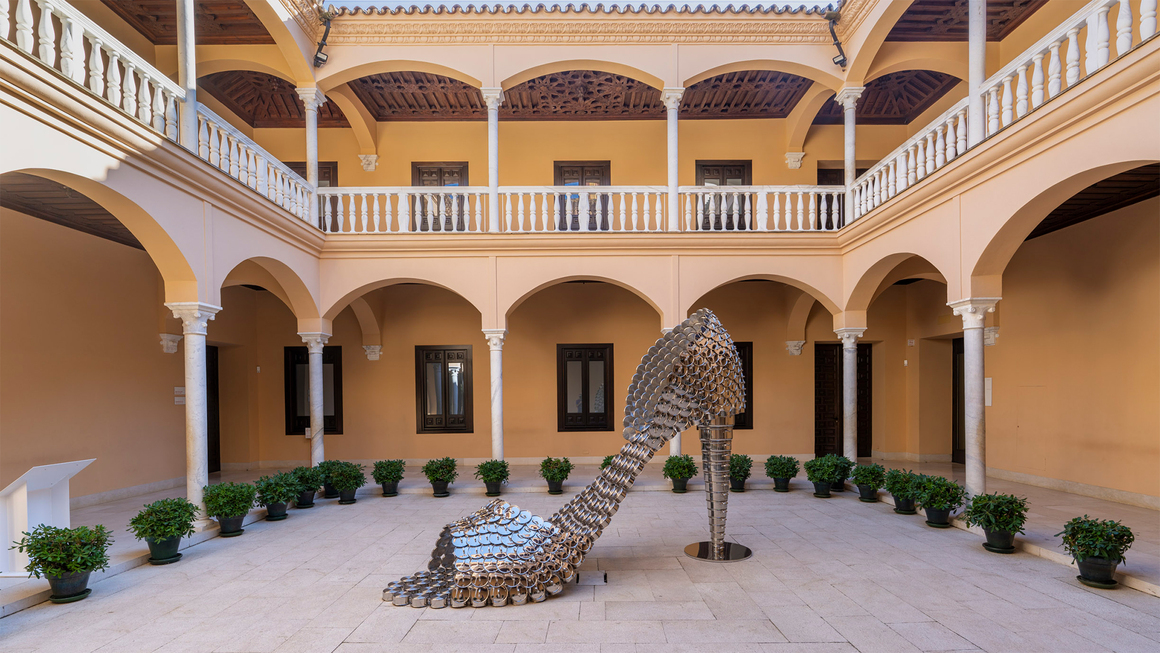
In the central courtyard of the museum’s sixteenth-century Buenavista Palace stands Betty Boop (2020). Named for the 1930s animated sex symbol—a caricature of the carefree flapper—Vasconcelos’s sculpture exaggerates the painful proportions of a stiletto, highlighting the sexism and denial of free movement the shoe evokes. In an interview with the exhibition’s curator Miguel López-Remiro Forcada, artistic director of the Museo Picasso Málaga, Vasconcelos likens the sculpture’s abstract forms to those in Picasso’s cubist masterpiece Les Demoiselles d’Avignon (1907), which depicts women working in a Barcelona brothel, as shapes that are simultaneously there and not there. In Betty Boop the shapes that emerge and recede from our awareness are stainless-steel cooking pots and lids in various sizes—an ingenious construction solved entirely through the proportions of the existing objects.
Vasconcelos’s maximalism is defined both by exuberance and the conflicted expectations that are often bound to women’s identity. Several works, such as J’Adore Miss Dior (2017), made of the namesake’s perfume bottles, read as creative merchandizing. But credit where credit’s due, the breadth of work her studio tackles, from the commercial to the white cube, means that Vasconcelos is able to employ fifty people, an impressive amount of jobs financed by an individual artist. And Vasconcelos is unlikely to agree with my reading of maximalism. Instead, she makes clear that “it isn’t the scale that I care about but the space it generates.” While intended in relation to her sculptural work, the sentiment may be understood to apply equally to the ecosystems her enterprising approach supports.
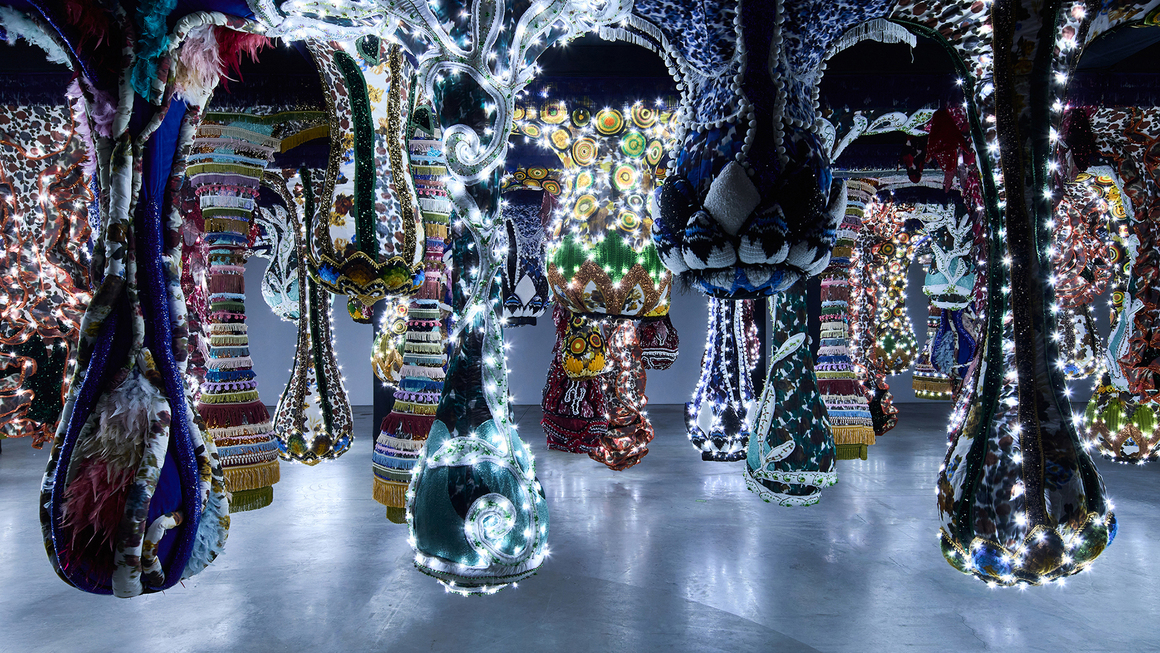
On the day of my visit, a study trip of teenagers was also in the museum. The group was a little excitable and just a little distracted, and I hopped between rooms, distracted too by my efforts to avoid them, until our paths coincided at the exhibition’s final artwork, Enchanted Forest (2024). The site-specific installation is illuminated with LED lights (softer in person than photography captures), and made, I learn later, from Dior fabric adorned with fringes and tassels. To my surprise, a palpable concentration fell over us all. Admittedly, time was given to selfies—the installation lends itself to the medium—but the room was also quiet. Walking in the textile forest, even the digitally distracted seemed to have truly been captivated. We were enchanted.
Jessica Hemmings writes about textiles. She is a professor of craft at HDK-Valand, University of Gothenburg, Sweden, and professor II at the Oslo School of Architecture and Design, Norway.
Joana Vasconcelos: Transfiguration is on view at the Museo Picasso Málaga, Spain, through September 26, 2026.