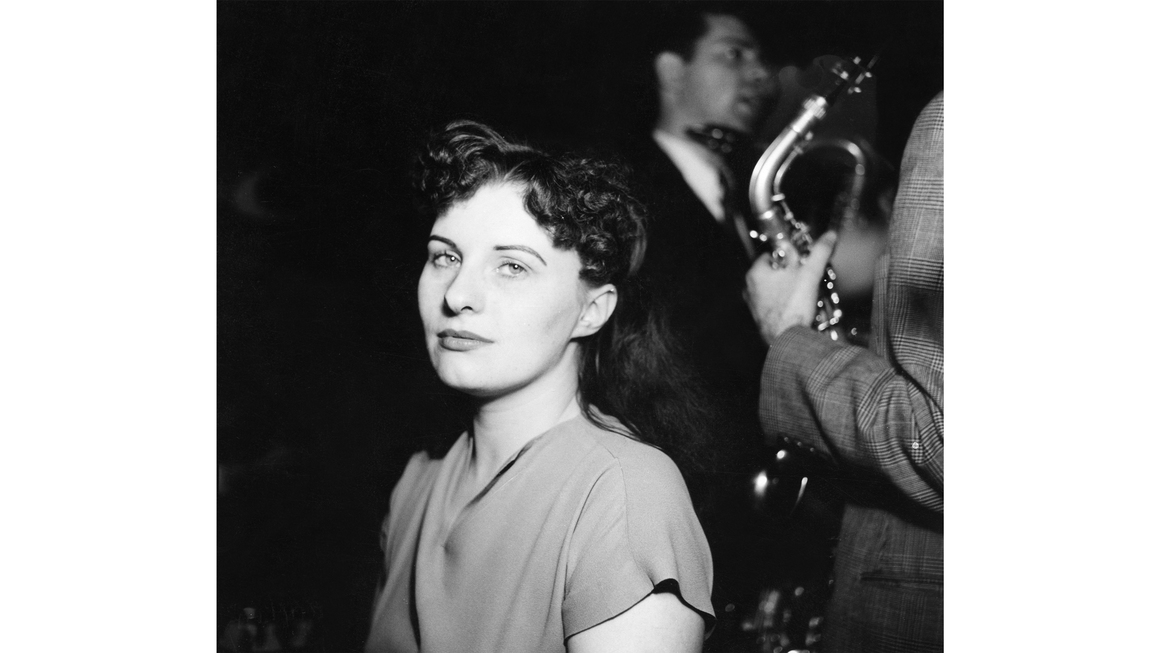
Charlie Mingus described her as “a great piano player.” She performed at the Newport Jazz Festival on the same bill as Mingus and Count Basie and toured with Dizzy Gillespie. She released six albums, including one with Zoot Sims, and was the first white woman and European instrumentalist to be signed to Blue Note Records, the leading modern jazz label of the era.
Despite her success, just four years after Jutta Hipp recorded her album with Sims, she abandoned music in 1960. For most of the next forty-three years, until her death in 2003 at the age of seventy-eight, she lived alone in Queens, subsisting on social security without health insurance or a piano. Blue Note described her as “one of the most intriguing yet little known figures” in its history.
Hipp’s passion for jazz and the piano was forged in Germany, where she was born in Leipzig in 1925. Her parents encouraged her love of music and painting, and she studied art after high school. By then, she had acquired an illicit love of jazz, which despite Nazi censorship, could be found on banned foreign radio stations. When Leipzig and the rest of East Germany became part of the Soviet bloc after the end of World War II, Hipp joined thousands of East Germans who fled to West Germany by walking across the Alps.
For the next decade, she made her name as a talented jazz pianist by performing throughout West Germany. In 1948, she had a son whose father was an African-American G.I. When he returned to the United States without them, Hipp arranged for the baby to be adopted. Seven years later, Hipp herself left for the States, helped by the jazz critic and composer Leonard Feather. He persuaded Blue Note to re-release one of her German albums and to record a new one with Sims. Feather also arranged for Hipp to play at Newport and to have a six-month residency at the Hickory House jazz club on West 52nd Street. Blue Note released two live albums of her work there, At the Hickory House Vol 1 and At the Hickory House Vol 2.
Hipp appeared to be poised for a dazzling musical career. Her talent was indisputable, not least as she was an instinctive pianist who played for pleasure, rather than to show off technically or stylistically, which explains why other musicians enjoyed working with her. But, within a year of arriving in New York she had fallen out with Feather and was becoming increasingly frustrated by the fiercely competitive—and misogynistic—music industry. Several gifted women had successfully established themselves as jazz singers, notably Ella Fitzgerald and Billie Holiday, but there were very few female jazz instrumentalists.
By the late 1950s, Hipp had become increasingly depressed and was drinking heavily. She performed less often, found work in a Queens garment factory, and moved from Manhattan into a cheap walk-up apartment nearby. By 1960 she had abandoned music and was focused on painting and drawing, occasionally selling her work at street markets. She soon lost contact with Blue Note and with most of her friends from the jazz scene. In 1969, Blue Note disappeared when it was closed by a new owner, Liberty Records.
In 1985, Blue Note was relaunched by the EMI music group, which re-released its vintage recordings, including Hipp’s, amid a resurgence of interest in modern jazz. The label ensured that the original musicians were paid royalties on their re-releases, but found it impossible to trace some of them, including Hipp.
In 2001, Blue Note’s general manager, Tom Evered, finally discovered her phone number and called to say that he planned to visit her in Queens to deliver a royalty check for $35,000. “Mein Gott,” was Hipp’s response.
A week after Evered’s visit, she sent a “thank-you” box of German cookies to Blue Note. Hipp died two years later, having received several smaller royalty checks, which, hopefully, made the end of her remarkable yet often arduous life a little easier.
Alice Rawsthorn is a London-based writer on design. The author of Hello World: Where Design Meets Life published by Hamish Hamilton, and, most recently, Design as an Attitude published by JRP Editions, she is a co-founder, with Paola Antonelli, senior curator of architecture and design at MoMA, New York of the Design Emergency podcast and research platform to investigate design’s role in building a better future.