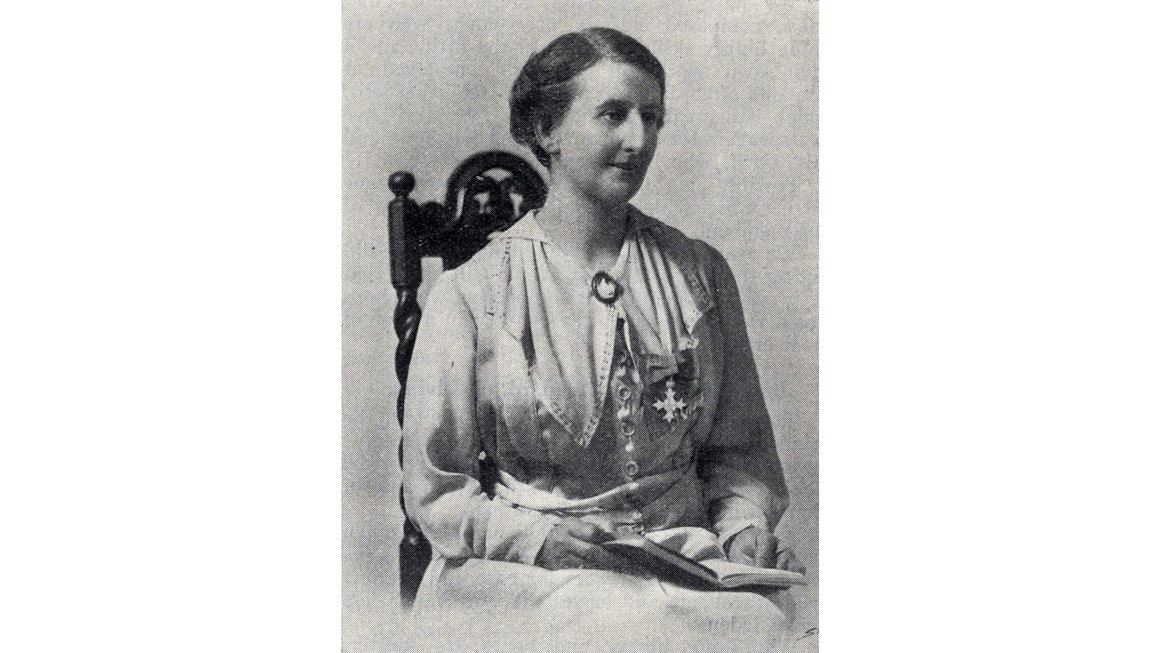
When Laura Annie Willson appeared in court charged with “inciting persons to commit a breach of the peace” at a rally supporting a workers’ strike in 1907, she demanded to be tried by a woman or to be represented by one. It was a provocative request, as there were no female judges or lawyers in Britain at the time, and she was sentenced to fourteen days in prison. “I went to jail a rebel,” she said after her release, “and came out a regular terror.”
Laura Annie’s imprisonment established her as a rising star of the women’s suffrage movement in Halifax, the industrial town where she lived in northern England. Her career as a suffragette would include another spell in jail, but also speeches at public meetings alongside the movement’s charismatic leader, Emmeline Pankhurst. Along with fighting for female enfranchisement, Laura Annie campaigned to improve the employment conditions and career prospects of working-class women like herself, while also establishing a successful business to design and build affordable homes for them and their families.
Not that it was easy. Laura Annie was born into poverty in 1877 as one of four children of two textile workers. Like her siblings, she left full-time education at the age of ten to spend three hours a day at school and six hours working in a textile mill. Her head teacher had tried to persuade her parents to allow her to continue full-time education, arguing that she was an exceptional student, but the family needed her meagre wages. Laura Annie worked full-time from the age of thirteen, and, two years later, joined a trade union, which swiftly appointed her as a branch secretary.
Through her commitment to trade unionism and socialism, she met George Willson, who came from a similar background, but being male, was able to be apprenticed in a skilled trade, in his case, metal working. When he and two friends lost their jobs after going on strike, they opened a lathe-making workshop. After Laura Annie and George married in 1899, she helped him with the business, and he encouraged her involvement in women’s suffrage and workers’ rights campaigns.
When World War I began in 1914, the workshop employed two hundred men, most of whom were conscripted into the army or war effort, prompting the Willsons to hire women to replace them. After the government ordered them to switch production to munitions, Laura Annie learned how to do the engineering work so she could ensure the new recruits were properly trained. She also established a day nursery for employees’ children and a canteen, as she knew that many factory workers went without meals to feed their kids. Showers, baths, and hot water were installed, and Laura Annie introduced a bonus system linked to each employee’s output. The government was so impressed that she was asked to advise manufacturers in the Midlands on how to increase productivity and improve working conditions. In 1917, she was made a Member of the Order of the British Empire (MBE) for her contribution to “women’s work in munitions.”
The Willsons fought to retain their female workers after the war but were forced to replace them with returning male soldiers. Undaunted, Laura Annie helped to found the Women’s Engineering Society in 1919 to encourage more women to work in engineering. She then cofounded the Electrical Association for Women, whose aim was to encourage the use of newfangled electrical equipment to save housewives from drudgery.
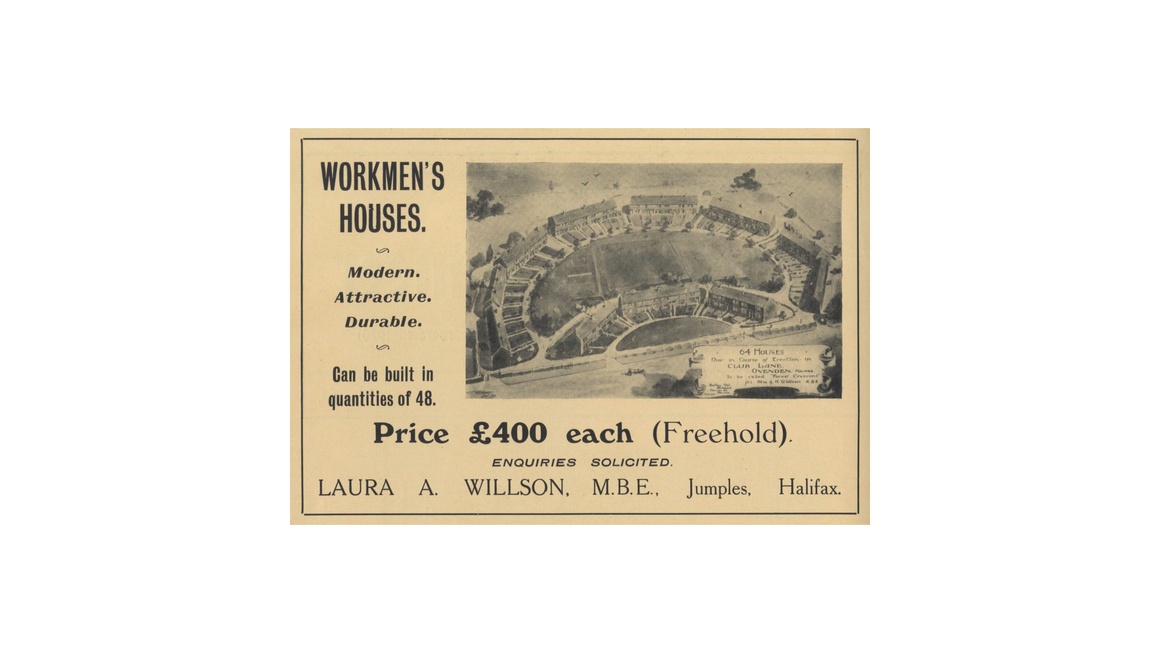
A similar principle inspired her most ambitious project, designing and constructing affordable homes. She began by building five hundred homes in Halifax, each of which was equipped with the latest labour-saving devices, a bathroom, a garden, and communal green space. Most of them faced south to make the most of the light, although Laura Annie also positioned them to reveal the best views of the surrounding greenery.
The Halifax estates were so successful that she was invited to build houses in southern England. She and George moved to Surrey in the late 1920s to oversee construction and stayed after retiring. Laura Annie died of heart disease in 1942, though only after becoming the first woman to join yet another male bastion, the Federation of House Builders.
Alice Rawsthorn is a London-based writer on design. Her books include Hello World: Where Design Meets Life published by Hamish Hamilton, Design as an Attitude published by JRP|Editions, and, most recently, Design Emergency: Building a Better Future, co-written with MoMA curator Paola Antonelli and published by Phaidon. She and Antonelli are co-founders of the Design Emergency podcast.