
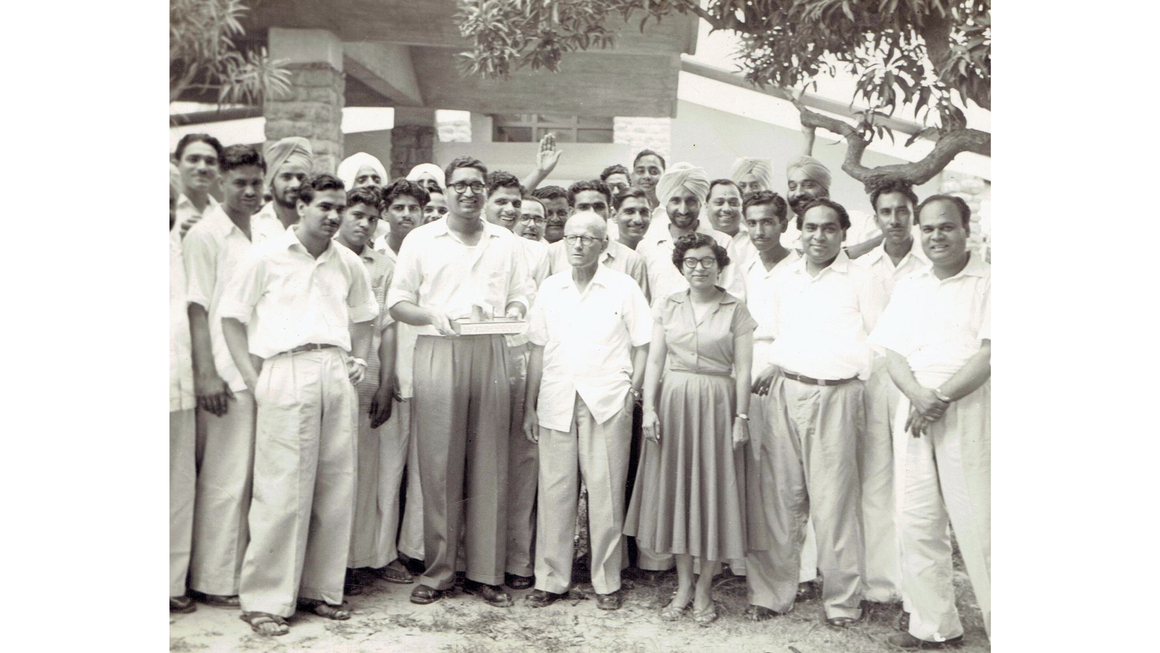
Every picture tells a story. But few of those stories are portrayed as vividly as a 1960 group photograph of the Indian architects who worked with Le Corbusier and his cousin Pierre Jeanneret on their epic project to design and build Chandigarh, a model modern city and new regional capital for the Punjab on a desolate plain in northern India during the 1950s and early 1960s. The photo shows Jeanneret standing beside a group of male architects, all smiling proudly in white cotton shirts, alongside a lone woman, Eulie Chowdhury, the only female Indian architect to work on the capital.
Chowdhury was not the first woman to practice architecture in India—her predecessors included Perin Jamsetjee Mistri—but she was among the first and was arguably its most influential female architect of the time. Having begun her career at Chandigarh, she became one of very few Indian women of her generation to be put in charge of major architectural projects, including large public buildings, there and elsewhere.
Crucially, Chowdhury did so on her own terms while resisting the pressure on so many female leaders of her era to adjust their personalities to suit a male-dominated environment. “What a woman Eulie was,” recalled the author Roopinder Singh after her death in 1995. “Petite, fiery and totally cosmopolitan.”
Born Urmila Eulie Chowdhury in the Uttar Pradesh region of India in 1923, she travelled extensively as a child, living wherever her diplomat father was posted. She then studied architecture and music in Australia, followed by a ceramics degree in the U.S., where she began her architectural career. In 1951, she returned to India determined to work on Chandigarh after reading about the plans.
Thanks to her fluency in English and French, Chowdhury soon became an indispensable conduit between Le Corbusier, Jeanneret, and the Indian architects on the project, as well as with local planners and politicians. Yet she was also involved in Chandigarh’s design from the outset, working with Le Corbusier on his first building there, the High Court. She remained there from 1951 to 1963, before becoming director of the School of Planning and Architecture in New Delhi, a post that she held from 1963 to 1965. After returning to Chandigarh in 1968, she designed some of her most important projects, including the Home Science College, the Government Polytechnic for Women, several schools, and politicians’ homes. Chowdhury was chief architect of the second stage of the city’s construction from 1971 to 1976, when she became chief state architect of Punjab. In addition to designing the city centres of Amritsar and Mohali in Punjab, she was the architect of dozens of hospitals, factories, and railway stations throughout India.
Throughout her career, Chowdhury shared Le Corbusier’s and Jeanneret’s elemental design values, notably their focus on efficiency, economy, modernity, and precision. Renowned for her diligence, she carried a large magnifying glass at all times to check the accuracy of each architectural plan and drawing. Yet she was equally assiduous in ensuring that her work responded to the demands of its location and climate, particularly in Chandigarh, where intensely cold winters are followed by the extreme heat of summer, and then by the storms and torrential rain of monsoon season. Writing in a 1961 special issue of Marg magazine devoted to Chandigarh, Chowdhury is a model of clarity and pragmatism, explaining how to make the best possible use of bricks, verandas, sun breakers, and detailed analyses of sun and wind movements when designing housing there.
She adhered to those values throughout her career while fostering public and political debate on important design issues, education especially. Yet after her death in 1995 at her home in Chandigarh, the tributes to her work particularly noted her vivacity, charm, and zest, as well as her authority in what was still largely a male domain. “People were scared of her,” recalled Renu Saigal, one of Chowdhury’s students, who later became chief architect of Chandigarh. “As the only girl in that group, I was apprehensive. What if I did something wrong? When I actually got to meet her, she was so nice. She inspired me to be like her.”
Alice Rawsthorn is a London-based writer on design. Her books include Hello World: Where Design Meets Life published by Hamish Hamilton, Design as an Attitude published by JRP|Ringier, and, most recently, Design Emergency: Building a Better Future, co-written with MoMA curator Paola Antonelli and published by Phaidon. She and Antonelli are co-founders of the Design Emergency podcast and research platform.
Related Stories


