
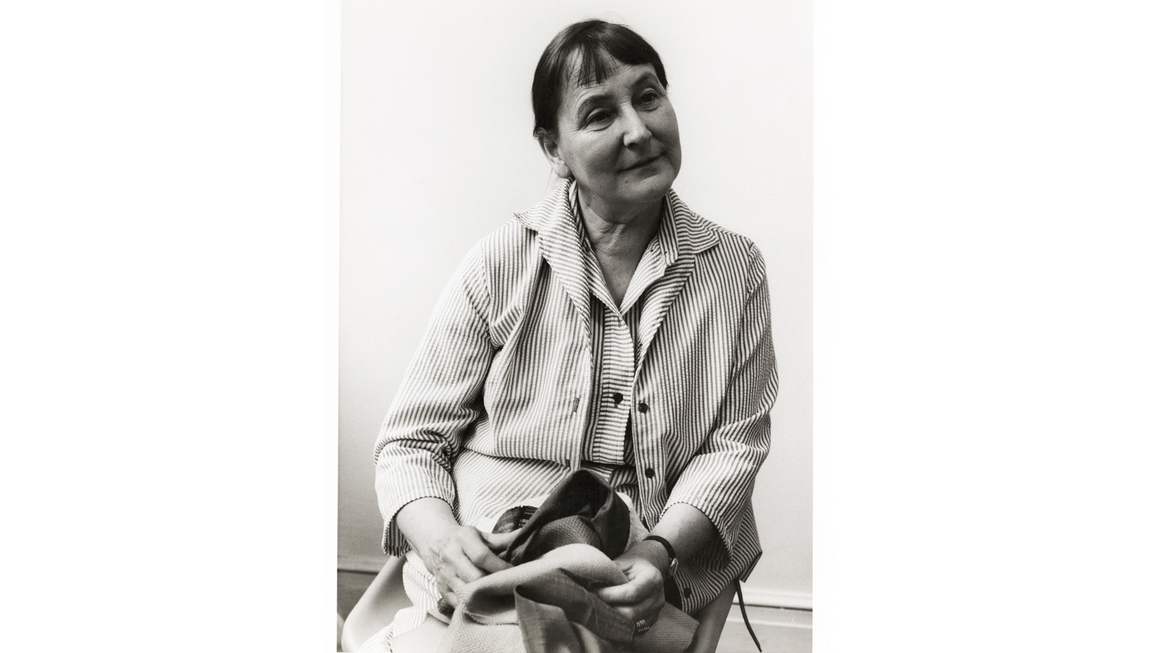
The first sign of trouble was that the letters sent from Bradford Technical College in northern England to a young Swiss weaver, Marianne Straub, were addressed to “Mr. Straub.” As women were not admitted to Swiss textile colleges in the 1930s, Straub had applied to Bradford and decided to accept its offer of a place, despite knowing that her application had succeeded on the misassumption that she was male.
Thankfully, she was allowed to enrol, albeit as the only woman on the course, and she seized the opportunity to explore all aspects of industrial textiles. Years later, she described her time there as: “Hard work but worth it. I learned so much. They were so kind to me, probably because I was the only girl and I really worked hard. I never went to bed before one in the morning.”
Challenging though it was, Straub’s experience in Bradford helped fulfil her ambition to design textiles for mass production. In doing so, she became one of the most prolific industrial textile designers in mid-20th-century Britain and one of the few women to forge a successful career in industrial design at the time. Even so, she has never been given the recognition she deserves, either by designers in other fields or by the public.
Straub was born in 1909, as one of four daughters of a textile merchant, Carl Straub, and his wife, Cécile Kappeler, in the Swiss village of Amriswil near Lake Constance. As a child, she contracted tuberculosis and spent four years in hospital, where she entertained herself by making things by hand. In her early teens, she became ill again and persuaded her parents to buy her a small loom with which she could experiment. After starting her formal education in textiles on the hand-weaving course in Zürich in 1928, she switched to industrial textiles in Bradford.
Upon completing her studies, Straub accepted an invitation to explore a very different approach to her field. It came from Ethel Mairet, a lynchpin of the British Arts and Crafts movement, who ran a workshop at Gospels, her home in the village of Ditchling on the South Downs, where she experimented with traditional hand-weaving techniques and invented new types of organic dyes. Straub flung herself into the experiments at Gospels and, as a quid pro quo, persuaded Mairet to try out power looms.
Although she and Mairet remained lifelong friends, Straub left Gospels in 1934 to return to industry as a design consultant for seventy-two weaving mills in Wales. Charged with modernising the mills, she created more than three hundred textile designs for them over the next three years, and she persuaded the Hungarian architect Marcel Breuer to use them in his furniture. She then became chief designer of Helios, an industrial textile manufacturer based near Manchester. In 1947, she was promoted to managing director, becoming one of the very few women to hold such a senior role in British industry.
When Helios was acquired by the larger Warner textile group, Straub was charged with establishing the combined companies at the forefront of innovation in industrial textiles. She relished the challenge of experimenting with advances in spinning, dyeing, and weaving to produce engaging and durable textiles for use in factories, offices, cinemas, universities, and other public buildings, as well as trains, buses, and the US embassy in London.
Much as she relished the challenge of designing at Warner, Straub sustained her passion for textile history and its artisanal traditions as a teacher at the Royal College of Art and a founder of the Crafts Study Centre, a national archive of craftsmanship. At the age of seventy, she conducted a World Bank research trip to Mali to analyse how to sustain its textile heritage. She died fifteen years later, having left the UK to live quietly in her native Switzerland towards the end of a remarkably productive working life in which she infused mass-manufactured textiles with the subtlety and spirit of craftsmanship.
Alice Rawsthorn is a London-based writer on design. Her books include Hello World: Where Design Meets Life published by Hamish Hamilton, Design as an Attitude published by JRP|Editions, and, most recently, Design Emergency: Building a Better Future, co-written with MoMA curator Paola Antonelli and published by Phaidon. She and Antonelli are co-founders of the Design Emergency podcast and research platform.
Related Stories


