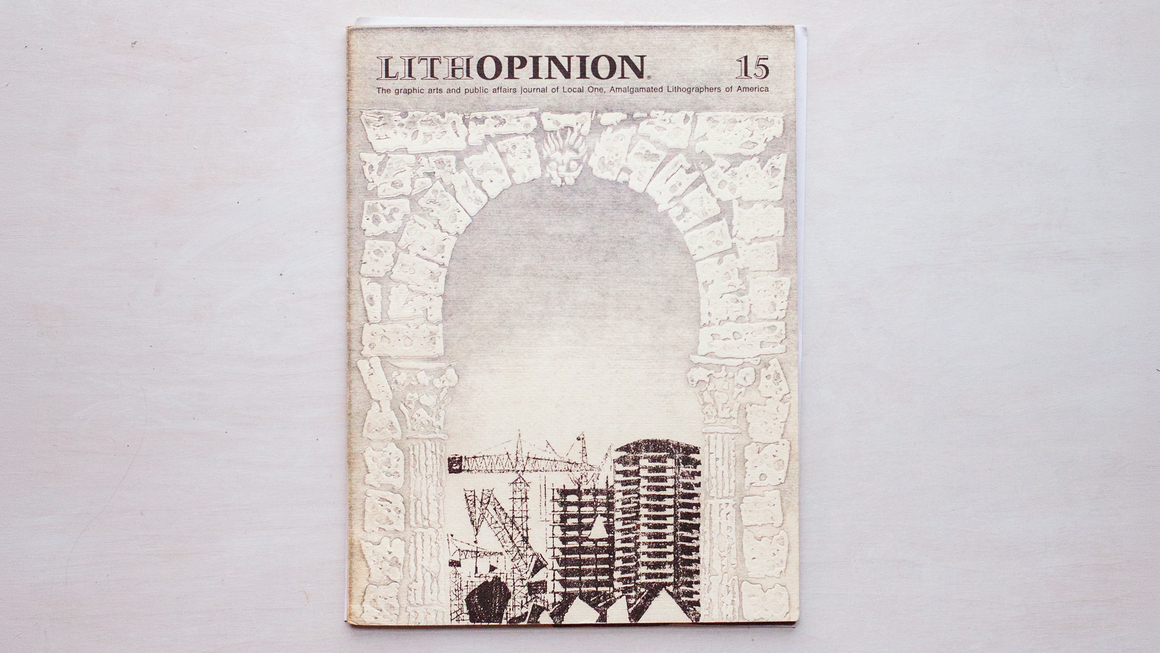
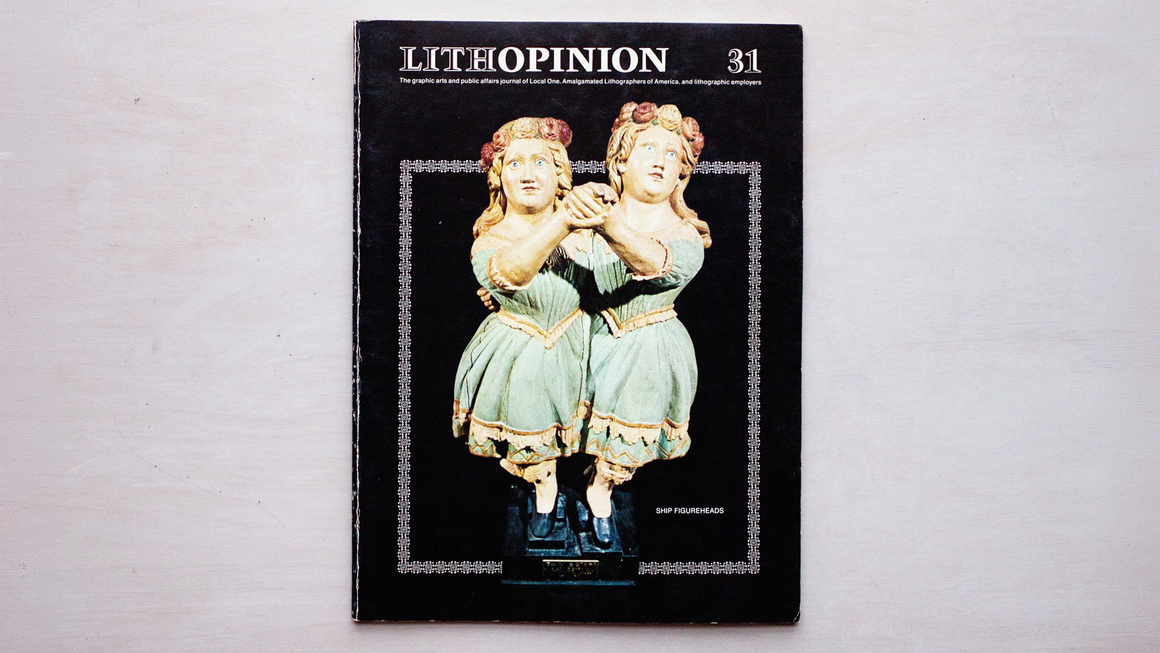
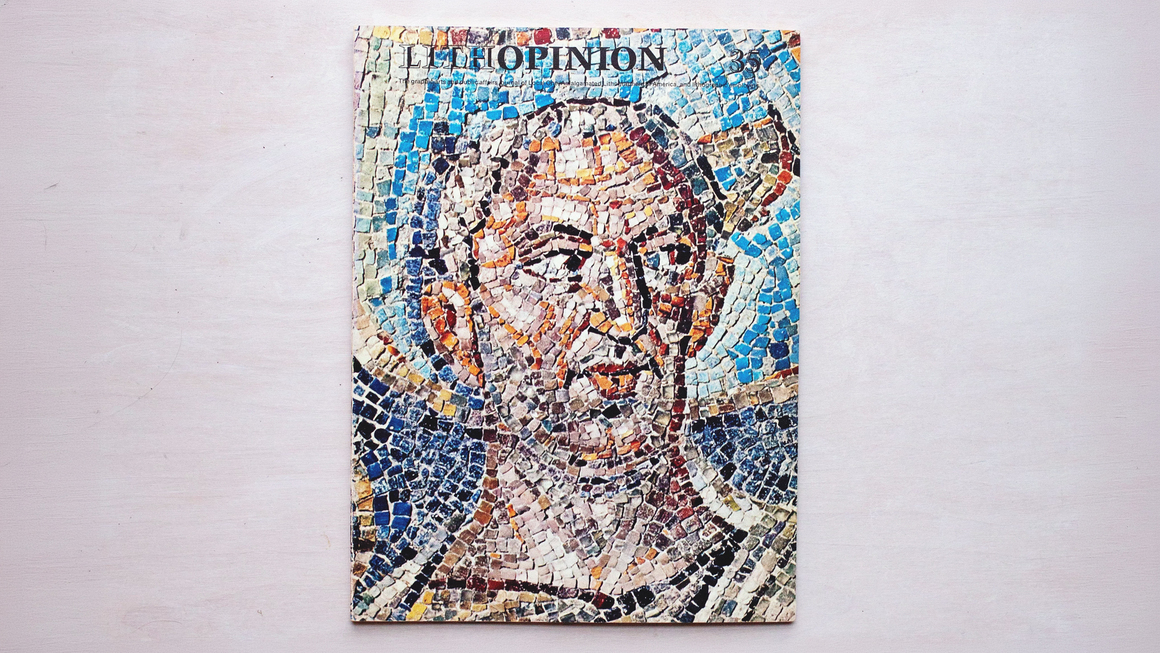
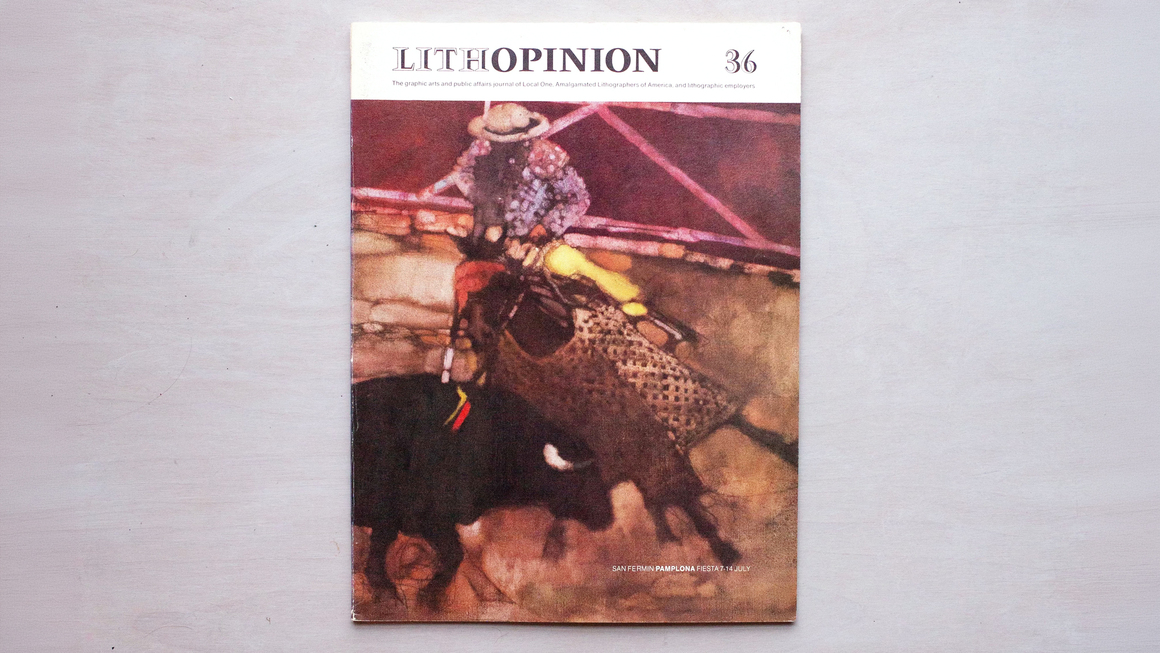
Oil and water don’t mix. But bring them together and the result is almost always interesting. For example: lithographs. Invented in the late 1790s by German author and actor Alois Senefelder, lithography uses a greasy substance, often tusche or crayon, applied to smooth limestone or a metal plate. The surface is treated with a chemical solution, then dampened with water and rolled with oil-based ink. The greasy drawing holds the ink and repels the water, enabling the design to be transferred to paper.
Said to be one of the most autographic of printing techniques, lithography retains the detailed marks of the maker. An art form but also a technological advance in mass communication, modern offset lithography is used for newspapers, books, maps, magazines, labels, and posters. Communication is art, and art communicates.
In 1965, the magazine Lithopinion was launched by Local One, Amalgamated Lithographers of America to explore the confluence of the two—art and communication—and to shine a light on the politics that impacted the working class. “Lithopinion is a quarterly journal devoted to experimentation in the arts that are graphic, elucidation of significant patterns in public affairs and examination of social and cultural change.”
At 9 by 12 inches, each issue of Lithopinion was printed in full color on heavy, catalogue-grade paper stock. Initially, it was free to Local One union members and select professionals in arts, education, and politics. Eventually it could be purchased by anyone who wanted it for six dollars an issue, roughly the cost of production. There were no advertisers. To maintain the integrity of its mission and the quality of the product, Lithopinion was made using donated paper and binding materials.
Even today, with countless special-interest journals to choose from, it stands out. Exceptional in its devotion to both serious politics and fine art, Lithopinon combined categories typically perceived as oil and water, featuring longform essays alongside multi-page spreads of poetry, painting, fiction, and photography.
Lithopinion was conceived of by the president of the Amalgamated Lithographers of America at the time, Edward Swayduck. Called one of the “most successful and least conformist of union leaders” by a CIA-archived article, Swayduck dumped money into innovations intended to streamline printing processes at a time when such techonology seemed a threat to job security. “Swayduck has fought the featherbedding that made many a printshop worker resemble, in Swayduck’s words, ‘the guy in the orchestra who waits for two hours, then bangs the cymbals together once,’” wrote Time magazine in 1957. Rather than a threat, Swayduck saw advances in technology as potential for growth. “If it helps get products to the consumer more cheaply,” he told Time, “it’s going to broaden activity in the industry and provide more jobs.” In the early 1960s, Local One was “not only the fastest-growing in the printing trades but also one of the best paid.”
Lithopinion magazine was as nonconformist as its founder. “We hope to help break up stereotyped ideas of what a union is,” Swayduck wrote in the first issue, published in November 1965. “We want to show what lithography can do. We want to run the whole gamut of our art.”
In any given issue, like the few I have, published between 1969 and 1975, the gamut is run. There’s a cover by Bernard Fuchs, an exposé on American healthcare, a multi-page photo-illustrated spread on weathervanes, a feature with full-page photos on the impact of strip mining; a photo essay on community gardens in New York City (by Marcia Kay Keegan, a rare appearance of female talent), a reprint of the short story “The Rocking-Horse Winner,” by D. H. Lawrence, a print by Robert Rauschenberg using the words of William Burroughs, and ten pages devoted to illustrations by Erté.
Serious, pointed, and idealistic, Lithopinion was also full of humor, whimsy, and awe about nature, art, and beauty. A few typical headlines:
“A Compendium of Things About Ducks,” by Dan Carlinsky, from the fall of 1973
“Early American Gravestones: The Iconography of Mortality,” by Francis Y. Duval and Ivan B. Rigby, from the fall of 1975
“Where Sea Meets Shore: Geologist/photographer Allen Rokach provides a glimpse of some of the ever-changing habits found at the land’s edge, and of strange and wondrous things that bravely live there,” from the fall of 1974.
For a time, it was edited by the storied longform journalist Robert Sherrill. Self-described as an “independent radical,” he famously wrote about landing on the Nixon administration’s “media enemies” list for issue 31 of Lithopinion, in the fall of 1973.
A couple years later, in 1975, for unrelated reasons likely to do with money and markets, Lithopinion was over. Looking back on it in 1985, Sherrill said it was “the most beautiful magazine you ever saw.” Today, it’s testament to the power of experimentation in the arts, and what happens when opposites attract.
Genevieve Walker is a nonfiction writer and magazine editor. She covers the intersection of contemporary culture and history in art, architecture, and design. She is currently working on her first book.
Related Stories