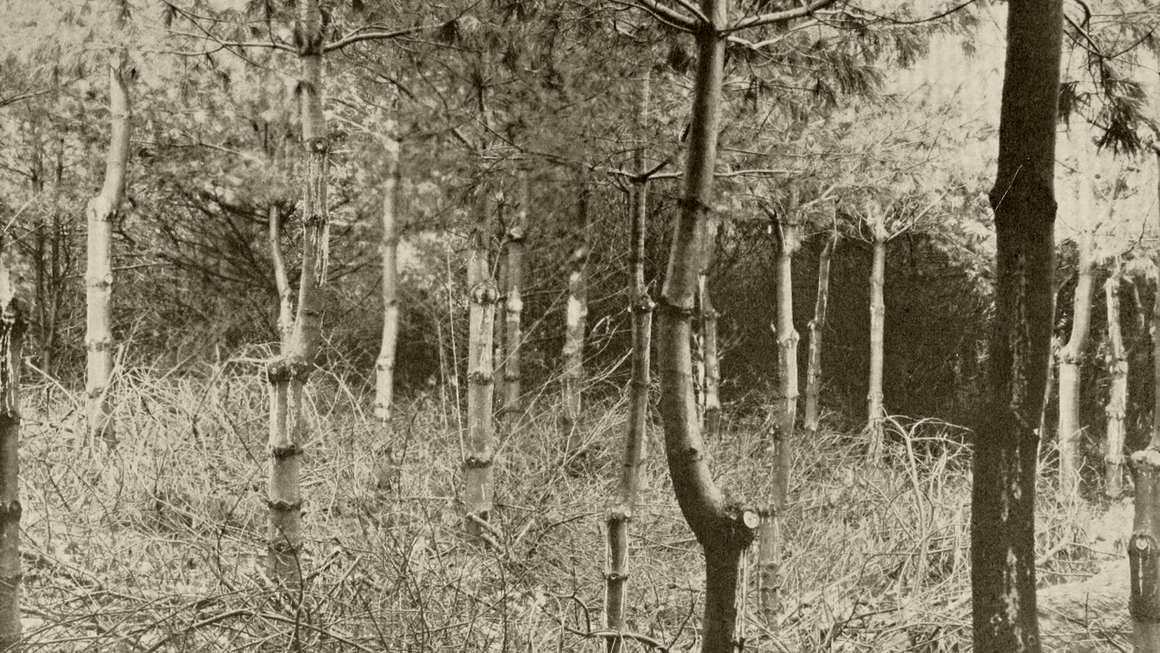
The Gilded Age may call to mind dusty garment factories, sooty mines, and steely railroads. But the expansion of these industries in the late nineteenth century, along with a growing consumer class, also created a voracious appetite for timber, sourced from the forests that covered much of the continent that the United States had claimed as its own. Forests provided timber not only for the wooden ties that bound railroad tracks together, for the mine shafts that tunneled into the earth’s depths, and for the charcoal used to smelt ores that emerged from within. They also furnished wood for fashionable wares, ranging from toys and furniture to apparel and medicine.
Hough’s American Woods, a catalog compiled by three generations of foresters, provides a glimpse into the consumer world that timber made at the turn of the century. Franklin Hough—dubbed “the father of American forestry” for his role as the first director of the United States Division of Forestry—conceived the project but was unable to initiate work before his death. His son Romeyn abandoned a career as a physician and dedicated his life to the project instead, publishing the first volume in 1888. His daughter completed the fourth and final volume in 1928 after Romeyn's death. The resulting catalog, representing over 350 total tree species, proclaimed to display “in as compact and perfect a manner as possible…specimens of our American woods” for “fancy and business purposes” alike.
American Woods touted the use of maple for pegs or ship keels, hardy white ash for fence rails, black larch for newly necessary telegraph poles, and tupelo for hatters’ molds and aqueduct pipes. Sumac and magnolia suited sitting rooms in the form of furniture inlays or cheeseboards, respectively, while poplar furnished sturdy but lightweight high heels for the ladies. Black spruce made fine material for string instruments and its sap a popular chewing gum, and birch could be enjoyed by the family as candy and soda.
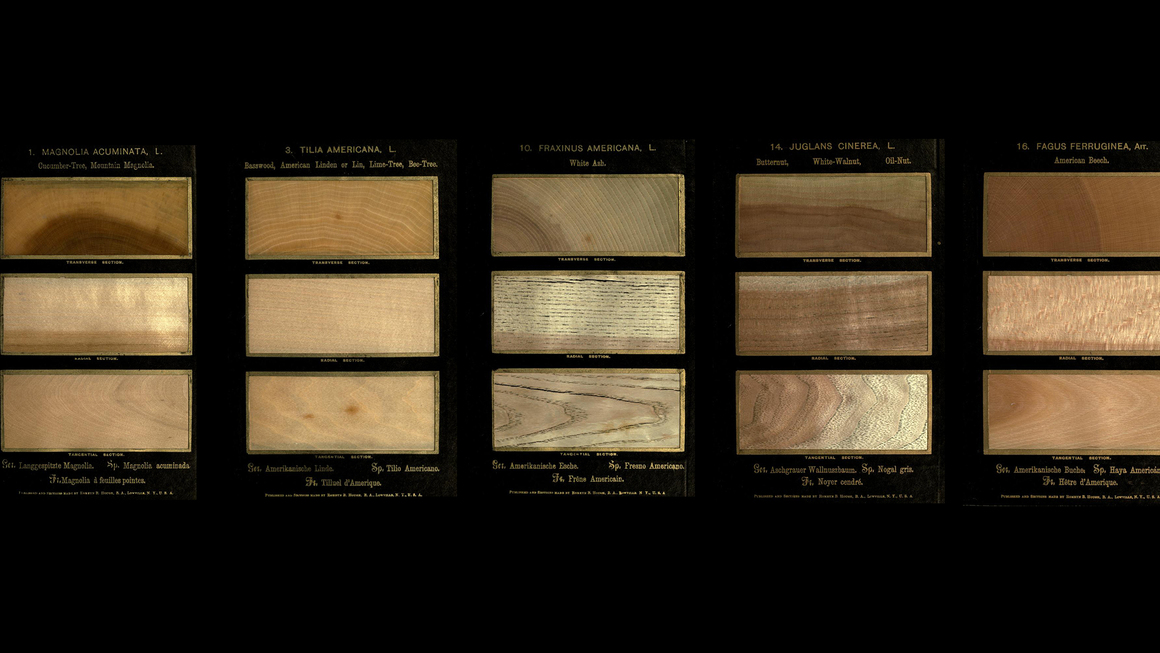
In addition to offering “copious” descriptions for the uses for American timber, each volume featured three types of cross sections of twenty-five tree species, allowing customers to observe the fine materials from every angle. Romeyn Hough selected tree specimens himself and patented a specialized cutter that could slice transverse, radial, and tangential cross-sections that would be thin enough to let light through and display unique patterns in the wood.
Although American Woods was ostensibly a catalog for selling timber, there is an austere, laconic beauty to the timber samples. Familiar woods such as maple and oak display the “peculiar freaks” of the grain (in Romeyn Hough’s words) that lend the woods their still-coveted qualities, while species like horse chestnut are astonishingly plain yet luminous. The inner cover suggested that the reader display the samples “before an audience” by magic lantern (an early form of projector) or microscope, as the samples were “authentic and elegantly prepared . . . giv[ing] a most perfect opportunity for studying the minute structure.”
The catalogs not only demonstrate the alluring organic beauty of wooden wares but also remind us of timber’s completely quotidian uses. While the Houghs’ role in the early days of American forestry might be misunderstood as solely starry-eyed conservationism, the development of professionalized forest management also helped to ensure a continuous timber supply. With its scores of meticulously selected and sliced samples, American Woods at once embodies a deep reverence for trees and the avid demand for their commodified value.
May Wang is a writer and PhD student in history based in Brooklyn.
Related Stories