“Respect for the material is unchanging,” wrote designer Clara Porset in her seminal 1949 essay “What Is Design?” “It must be used according to its inherent nature, and in keeping with the specific forms it produces. Honest forms could never be achieved if one material were forced into the form of another. Their deceitfulness would at once expose them as invalid.”
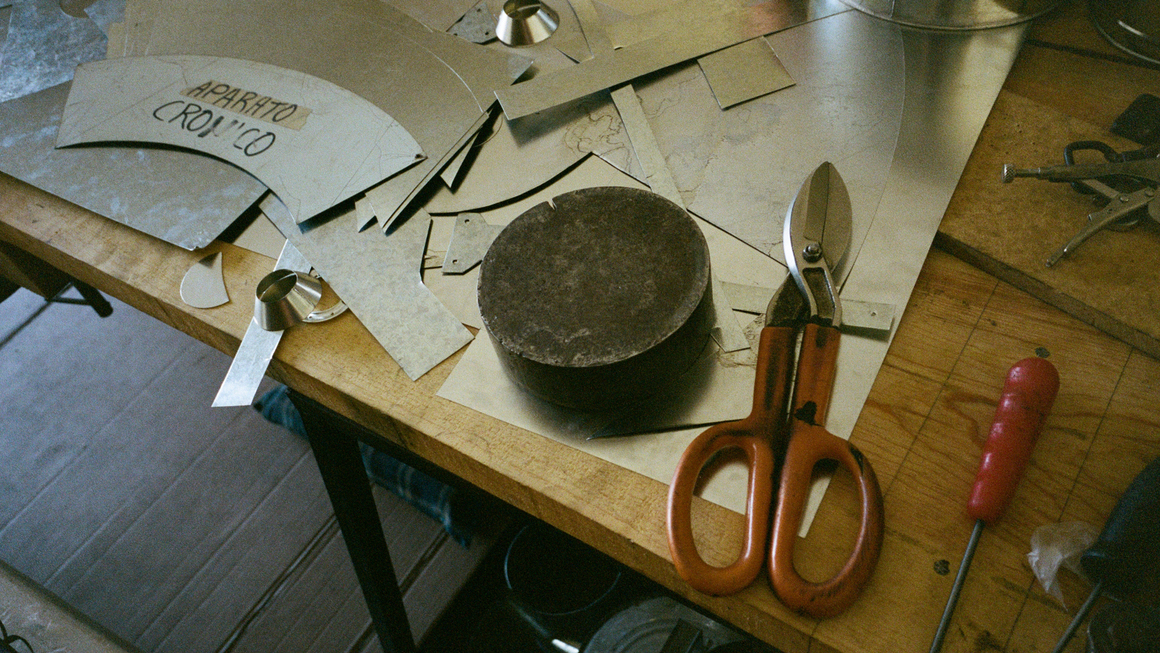
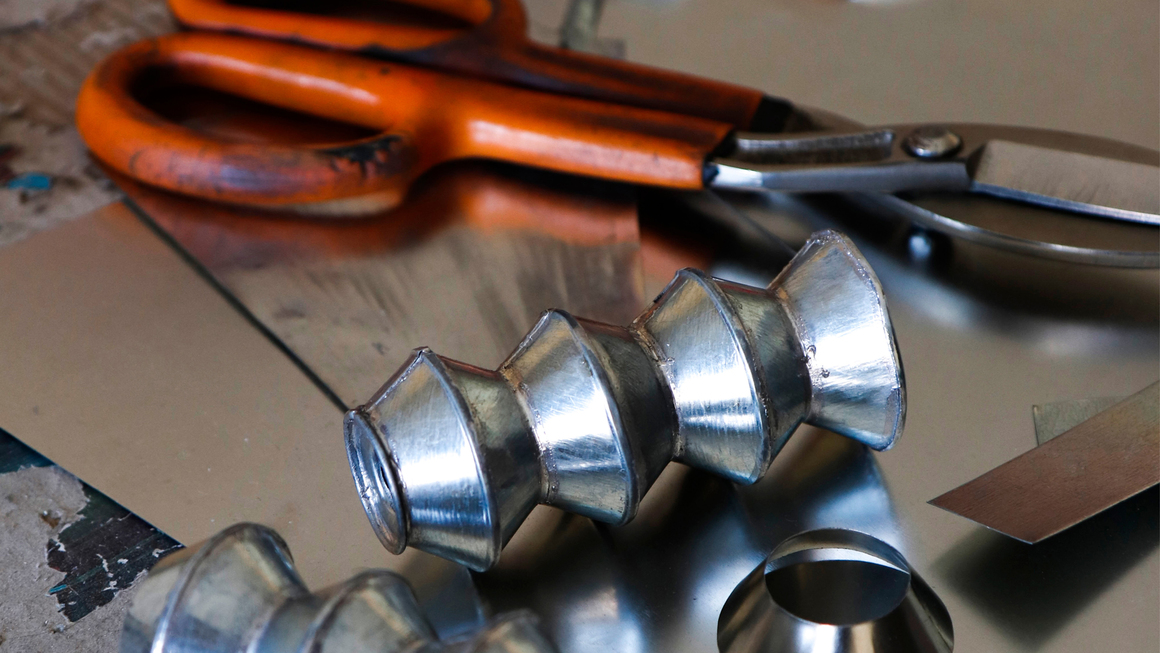
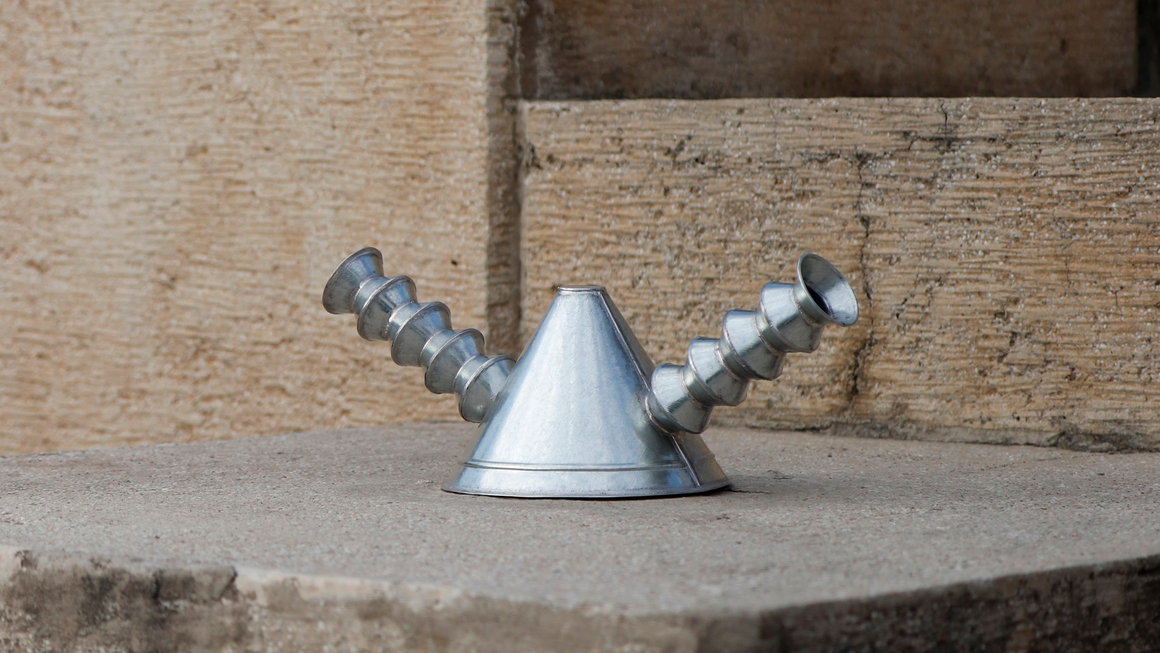
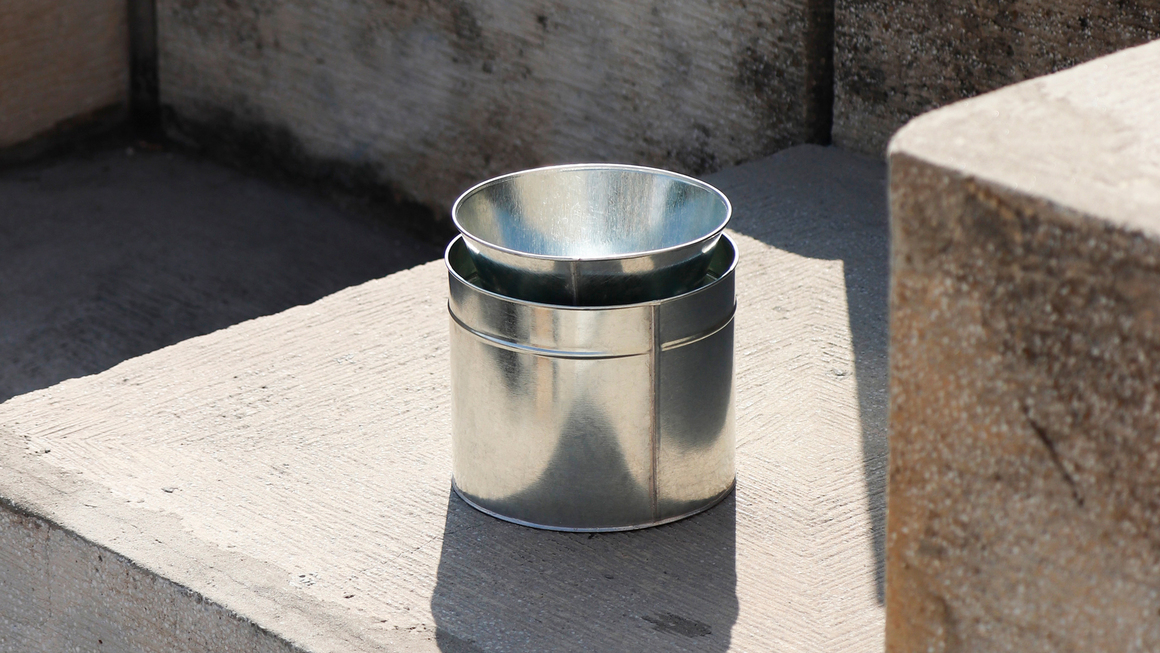
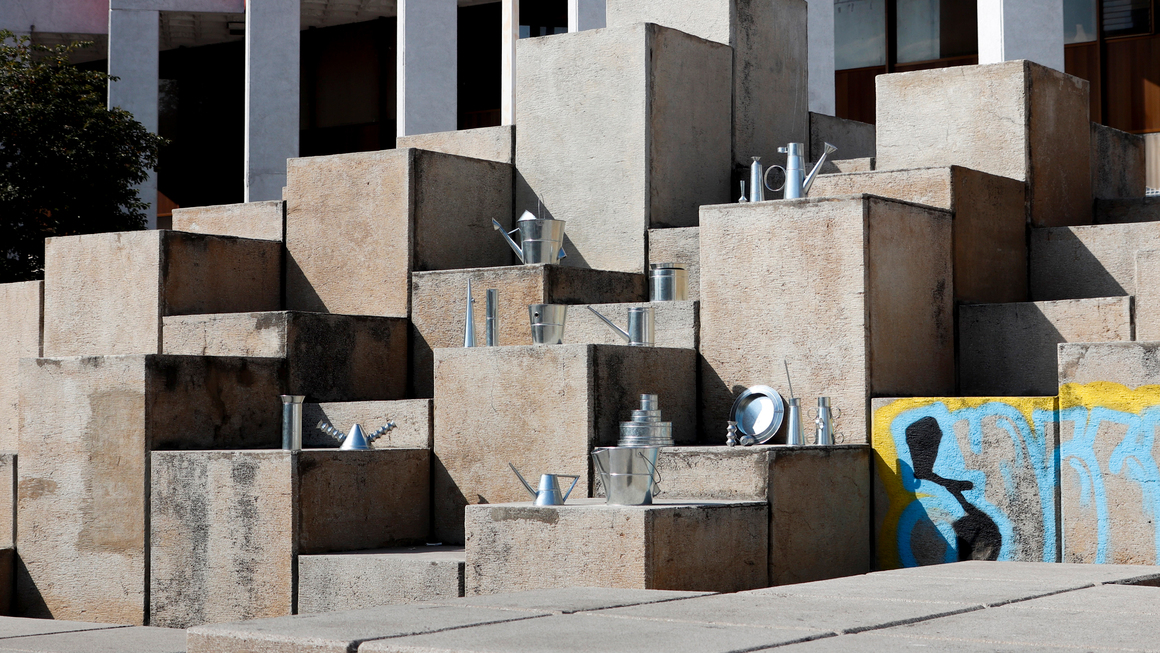
Perhaps one of the best examples of a material—and its corresponding trade—that demands this kind of respect is hojalata, which translates to tinplate or galvanized steel. Despite its industrial appearance, hojalatería work consists of hand drawing patterns onto unrolled metal sheets, which are then cut, rolled, and soldered by hand into cylindrical or conical volumes that go on to form the bodies of watering cans, buckets, vases, trays, and other everyday objects. Every detail remains visible, and the result is true to its form.
As with any design process, it is imperative to consider the collective, collaborative, and therefore human elements that the production process involves—from its conception to its manufacture, and ultimately its circulation in the market. In Guadalajara, Mexico, slowly disappearing cottage industries resist the post-industrial globalized market by relying on the localized microeconomy that supports them.
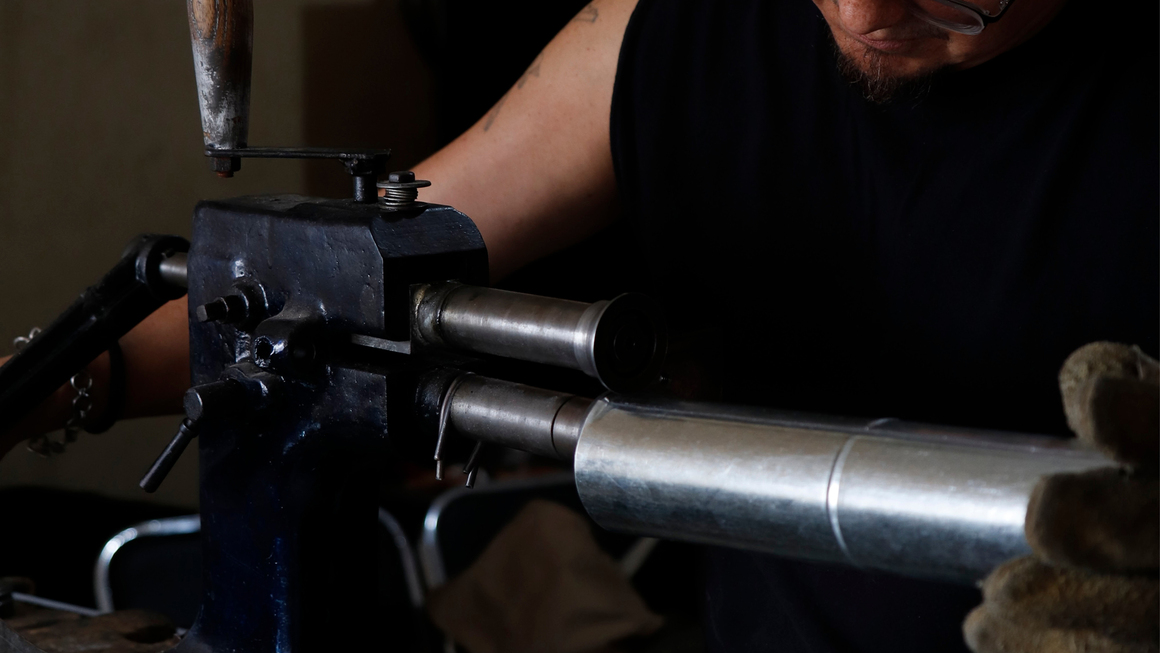
María Guadalupe Gil and Arturo Vega, originally from Capulhuac, State of Mexico, arrived in Guadalajara as teenagers following a job offer at an hojalatería. Ten years later, they started their own taller. Working from their home in the Analco neighborhood, the couple fulfills custom orders tailored to their clients’ needs. Using shears, pliers, hammers, and wooden mallets, they shape their pieces by hand, relying on hand-operated rolling machines and bending brakes when needed. Their work is not merely a trade but a true craft; no two pieces are exactly alike. On a typical workday, Gil and Vega can produce up to two hundred trays. Thanks to their adaptability, they sell both to craft markets like the one in Tonalá, Jalisco, and hardware and household supply stores in downtown Guadalajara.
It is through these markets that French-born, Mexico-based designer Fabien Cappello began studying the informal and mostly family-run local industry of Guadalajara’s hojalaterías. His interest goes beyond hojalata’s formal aspect, essential though that is, and delves into the local economy that produces and sustains it. Through institutional, grant-based research, and as part of his independent design practice, Cappello seeks to identify “prototypes for the future” that might offer alternatives to a Western understanding of production within the capitalist market.
Through his eponymous design studio, Cappello iterates on design concepts that have already been proven but which often go unnoticed. He then integrates an idiosyncratic layer, seeking to capture the curiosity of those who wouldn't have otherwise given the object a second thought. And as an educator, he seeks to collaborate with design institutions to help foster a closer relationship between designer, material, and maker.
Together with Gil and Vega, Cappello put together a small collection called Objetos de Hojalata para el Hogar. In 2021, Jasper Morrison—hailed for championing the understated—introduced their watering cans via his online shop. Word got around, and Cappello soon began noticing copies of their designs being sold in the outskirts of Guadalajara in the markets of Tlaquepaque and Tonalá. He finds these replications and reinterpretations rewarding. “Growing up in the West, we have the wrong idea of intellectual property,” Cappello says, “We are copied a lot [and] I could not dream of anything better. I want to be a designer because I want to have an impact.”
In October 2025, Cappello was invited by Leon Ransmeier, Artist-in-Residence at the Industrial Design department of Cranbrook Academy of Art, to conduct a collaborative workshop with a cohort of seven graduate students. The first session took place on campus in Bloomfield Hills, Michigan, followed by a trip to Gil and Vega’s workshop in Guadalajara three months later. Having sent their design templates in advance, the students had the opportunity to see their finished objects upon arriving in Mexico. As is often the case with Cappello’s work, Gil and Vega suggested necessary adjustments, thereby fostering a mutual understanding regarding the material and its processes, despite a language barrier.
The adaptability that characterizes Gil and Vega’s work ensures that the business can continue for several more years. Currently, three of their four children contribute during their spare time; however, the work is very isolating, and it is unlikely, barring necessity, that they would wish to inherit it given their promising academic educations with job prospects in the city.
For Cappello, he aims to transition an avenue of inquiry that originated with industry towards a more academic approach, embracing a close relationship between designer and artisan to create a dialogue that both honors what the material itself dictates before it is transformed and understands the importance of the simple tools that shape it.
Natalia Torija is a New York City-based architecture and design historian.
Objetos de Hojalata para el Hogar, an exhibition with Cranbrook Industrial Design, will be on view at Maharam's New York showroom May 15-28.